What is Demon Difficulty in Geometry Dash? (Complete Guide: All Tiers, Levels & Tips)
If you have been playing Geometry Dash for a while, you have probably seen the word “Demon” attached to some levels and wondered what exactly it means and why players seem to treat it like a completely different game. This guide explains everything about Demon difficulty: what it is, how it works, the five tiers within it, what the most famous Demon levels are, and how to actually start clearing them.
What Does “Demon” Mean in Geometry Dash?
In Geometry Dash, every level both official and community-made is assigned a difficulty rating. The ratings go from easiest to hardest: Auto, Easy, Normal, Hard, Harder, Insane, and finally Demon. Demon is the highest official difficulty tier in the game, represented by a skull icon and awarded 10 stars upon completion.
What makes Demon different from every other difficulty is that it is not a single tier it is a category that contains five sub-tiers of its own, each dramatically harder than the last. A level rated “Easy Demon” and a level rated “Extreme Demon” are both technically Demon levels, but they may differ in difficulty by hundreds or even thousands of hours of practice.
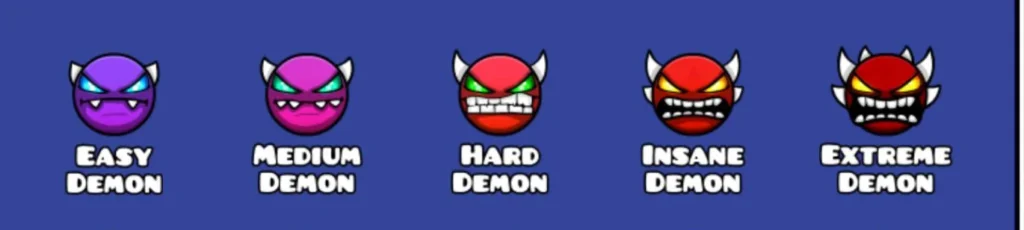
The Five Demon Tiers Explained
When a level is rated as Demon, the community and the game further classify it into one of five sub-tiers:
Easy Demon
Easy Demon is the entry point into Demon-level content. These levels are still significantly harder than anything in the Insane category, but they are manageable for players who have solid fundamentals and consistent timing. Expect:
• Moderate speed with tight but readable obstacles
• Wave and Ship sections that require focus but not pixel-perfect precision
• Most players can clear an Easy Demon within a few days to a few weeks of focused practice
• Typical attempt counts before a first clear: 500 to 2,000
Well-known Easy Demons include: The Lightning Road, Fairy Dance, and Clubstep (the official campaign level).

Medium Demon

Medium Demon is a noticeable step up from Easy. These levels require stronger mechanics across all game modes and a higher level of consistency. Expect:
• Faster sections with less reaction time
• More demanding wave corridors and ship sequences
• Dual mode sections requiring simultaneous control of two characters
• Typical attempt counts: 2,000 to 8,000
Players working toward Medium Demons should be consistently clearing Easy Demons before moving up.
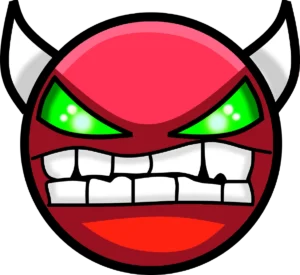
Hard Demon
Hard Demon is where the skill gap becomes very significant. These are some of the most famous and well-known levels in the entire game. Expect:
• Long levels with intense, multi-mode sequences
• Wave sections that require near-perfect precision throughout
• Many of the most iconic community creations sit at this tier
• Typical attempt counts: 5,000 to 20,000
Famous Hard Demons include: Theory of Everything 2 (the official campaign level), Bloodbath (one of the most recognized community levels ever made), and Cataclysm.
Insane Demon
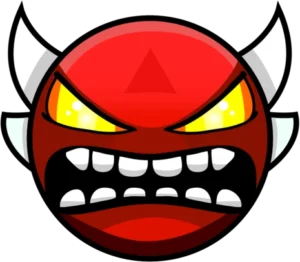
Insane Demon is near the absolute limit of what most dedicated players will ever clear. Very few players outside of the most committed community members reach consistent clears at this tier. Expect:
• Extremely tight timing across every game mode
• Long levels with almost no easy sections
• Wave corridors that require frame-perfect movement
• Typical attempt counts: 15,000 to 60,000+
Extreme Demon
Extreme Demon is the highest difficulty tier in all of Geometry Dash. These are considered the hardest playable levels ever created. Only a small number of players in the entire global community have cleared top-tier Extreme Demons. Expect:
• Pixel-perfect precision required for extended sequences
• Thousands of hours of practice for the hardest examples
• Global ranking on the community-maintained Demonlist
• Typical attempt counts for the hardest levels: 100,000+
Famous Extreme Demons include: Tartarus, Bloodlust, Slaughterhouse, and Acheron. These levels represent the absolute peak of human performance in the game.

The Geometry Dash Demonlist
The Demonlist is a community-maintained ranking website that tracks the hardest Extreme Demon levels in the game by difficulty. It is run and maintained by a dedicated team of experienced players who evaluate new levels and update positions when harder levels are released.
The Demonlist only covers Extreme Demons the very top of the skill ceiling. Most players will never interact with the Demonlist directly, but it is important to understand because it defines what “hardest level” means in the Geometry Dash community at any point in time.
Official Demon Levels in the Campaign.
There are three officially-rated Demon levels built by RobTop Games in the main campaign. These are only available in the full paid version of the game:
Demon Levels
| Level | Campaign Number | Demon Rating | Notes |
|---|---|---|---|
| Clubstep | Level 14 | Easy Demon | The first Demon most players encounter. Long with multiple dangerous sections. |
| Theory of Everything 2 | Level 18 | Medium-Hard Demon | Ship-heavy and technically demanding throughout. |
| Deadlocked | Level 20 | Hard Demon | The final campaign level. Fast, relentless, with almost no rest sections. |
These three levels are considered the gateway into understanding what Demon difficulty actually feels like in practice.
How Are Demon Levels Rated?
Official Levels
For official campaign levels, RobTop himself assigns the difficulty rating. The Demon rating on Clubstep, ToE2, and Deadlocked reflects his own assessment of their challenge.
Community Levels
For community-made levels, the process is different:
1. A creator publishes a level to the online browser.
2. Players rate the level using the in-game rating system.
3. If enough players rate a level as Demon, it receives a “featured” or “epic” tag and eventually gets a community difficulty vote.
4. Experienced members of the rating community evaluate the level and assign it an Easy, Medium, Hard, Insane, or Extreme Demon sub-rating.
This system means that community-rated difficulties are not always perfectly consistent, but the broader community generally agrees on major placements.
How to Start Playing Demon Levels:
Step 1: Master the Official Campaign First
Before attempting any Demon-rated level, make sure you can complete the full official campaign all 21 levels, including Deadlocked. The campaign is specifically designed to prepare players for harder content.
Step 2: Use Practice Mode Extensively
Practice mode is the most important tool for learning Demon levels. You can place checkpoints anywhere in the level and retry difficult sections without restarting from the beginning. This is essential for:
• Learning dangerous wave or ship sections in isolation
• Memorizing portal placements and gravity changes
• Building consistency in the hardest parts before running full attempts.
Step 3: Start With the Right Easy Demons
Some Easy Demons are better starting points than others. Look for levels that are consistently rated Easy Demon by the community, with a smooth difficulty curve throughout the level, levels that spike dramatically in one section and are easy everywhere else can actually be harder to learn than a Medium Demon with even difficulty throughout.
Step 4: Track Your Progress
Many players use a personal list or journal to track which Demon levels they have completed, how many attempts they took, and what they are currently working on. Seeing progress over time is important for staying motivated through the high attempt counts Demon content requires.
Step 5: Build Consistency, Not Just Completion
Clearing a Demon level once is exciting, but building the ability to clear it reliably shows that your mechanics have actually improved. Try to clear levels multiple times before moving to harder content.
Common Mistakes Players Make When Starting Demon Content.
Jumping to Extreme Demons too early: Many new players see Extreme Demon content in videos and try to replicate it before they are ready. This leads to frustration and discourages improvement. The progression through Easy → Medium → Hard → Insane → Extreme Demon exists for a reason.
Not using practice mode: Running full attempts over and over without checkpoints is inefficient, especially for long Demon levels. Practice mode dramatically reduces the time needed to learn new sections.
Only doing full runs after minimal practice: For harder Demons, you should be able to hit key checkpoints consistently before switching to full attempts. If you cannot consistently reach 50% in practice, running full attempts will not help much.
Ignoring the music: Geometry Dash is fundamentally a rhythm game. Demon levels, especially well-designed ones, have obstacle patterns that sync to the music. Learning the soundtrack makes patterns more predictable.

Frequently Asked Questions
How many attempts does it take to beat a Demon level?
The number of attempts depends on the difficulty and your experience. Easy Demons may take a few hundred to a couple thousand attempts, while top Extreme Demons can require over 100,000 attempts from even highly skilled players.
Can I play Demon levels in Geometry Dash Lite?
No. Geometry Dash Lite does not include the official Demon levels. To access Clubstep, Theory of Everything 2, Deadlocked, and community-created Demon levels, you need the full version of the game.
What is the hardest Demon level in Geometry Dash?
The hardest Demon level changes over time as new levels are created and verified. Community rankings such as the Demonlist track the most difficult Extreme Demons, with levels like Tartarus and Acheron remaining among the most well-known.
Do Demon levels reward more stars than normal levels?
Yes. Every Demon-rated level awards 10 stars after completion, making it the highest star reward available for a single level in Geometry Dash.
Do all Demon difficulties use the same skull icon?
Yes. All Demon levels share the same skull icon in-game. The labels Easy Demon, Medium Demon, Hard Demon, Insane Demon, and Extreme Demon are community difficulty categories rather than separate in-game icons.
What is Noclip in Geometry Dash?
Noclip is an unofficial cheat that allows players to pass through obstacles without dying. It is often used for practice or testing in modded versions but is not available in the official game and is not considered valid for legitimate completions.
Extreme Demon vs Insane Demon, What is the Real Difference?
This is one of the most common questions new players have, and honestly it makes sense to ask. Both sound extreme. Both sound hard. But in practice, the gap between them is massive.
Insane Demon is the second hardest tier. These levels push your mechanics to a point where most casual players will never reach a clear. You are looking at tight wave corridors, fast ship sections, and very little breathing room. Attempt counts typically range from 15,000 to 60,000 before a first clear and that is for players who are already decent at the game
Extreme Demon is a completely different conversation. These are the hardest levels that exist in Geometry Dash, period. The precision required is not just “very good” it is frame-perfect for extended stretches. Top tier Extreme Demons like Tartarus, Bloodlust, and Acheron have been cleared by only a handful of players worldwide after months or years of dedicated practice. Attempt counts can exceed 100,000 easily, and for the absolute hardest levels, some players have put in 200,000+ attempts before a single clear.
The simplest way to think about it:
Insane Demon vs Extreme Demon
| Insane Demon | Extreme Demon | |
|---|---|---|
| Skill required | Very high | Elite level only |
| Typical attempts | 15,000 – 60,000 | 100,000+ |
| Who can clear | Dedicated players | Top tier community |
| Famous examples | Bloodbath, Cataclysm | Tartarus, Acheron, Bloodlust |
| On the Demonlist | No | Yes |